


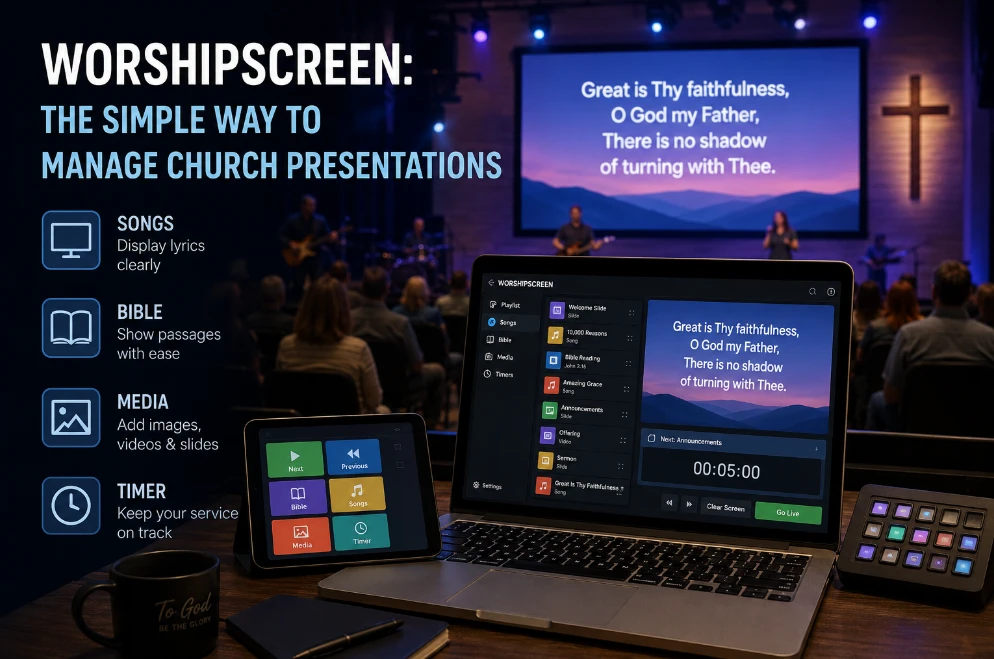
Church presentation becomes complicated when every part of the Sunday service is managed separately. Worship lyrics may be stored in one place, Bible verses in another, sermon slides in a third, while the presentation operator is expected to connect everything moments before the service begins.
For churches looking to reduce this complexity, a more organized presentation workflow can make a significant difference. Instead of treating lyrics, Scripture, and sermon content as unrelated tasks, the media team can prepare them as connected parts of one service.
The Real Cost of Manual Presentation Work
Manual preparation does not always look like a serious problem.
Copying a song into slides may take only a few minutes. Formatting a Bible passage may take another few minutes. Finding an announcement graphic is easy enough.
But these tasks happen every week.
Over time, volunteers spend hours performing repetitive work that could be simplified.
There is also another cost: mistakes.
Every time content is copied manually, there is a possibility of:
- Missing a verse
- Using the wrong lyric version
- Displaying an outdated announcement
- Putting songs in the wrong order
- Creating inconsistent formatting
- Forgetting an important service element
A better presentation workflow reduces both the time and the number of opportunities for human error.
Turn the Sunday Service Into One Presentation Plan
Rather than preparing individual files independently, start by creating the complete service sequence.
For example:
Welcome
Worship Song 1
Worship Song 2
Bible Reading
Sermon
Response Song
Prayer
Announcements
The exact order will vary between churches, but the principle remains the same.
Every presentation element should have a defined place.
This gives the media operator a clear roadmap and makes it much easier to identify missing content before Sunday.
Why Integrated Presentation Matters
When worship lyrics, Bible verses, and sermon slides are managed through disconnected tools, volunteers constantly switch between systems.
That creates friction during preparation and live operation.
A unified approach can make the workflow more natural.
For example, church presentation software can be considered by churches that want to organize different types of Sunday content within a more connected presentation environment.
The benefit is not simply having more features.
It is reducing the number of separate steps between receiving the service plan and presenting it to the congregation.
Make Worship Lyrics a Reusable Resource
A church often sings many of the same songs repeatedly.
There is little reason to recreate the presentation for a song every time it appears in the service.
Once a song has been checked and formatted correctly, it should be easy to reuse.
This is particularly useful for churches with regular worship sets.
A reusable song library can help the team:
- Find songs quickly
- Maintain consistent formatting
- Reduce repetitive preparation
- Organize songs by service
- Make changes when arrangements differ
The media team can then spend more time preparing new material instead of rebuilding familiar songs.
Keep Different Arrangements Under Control
Reusing content does not mean assuming that every performance is identical.
A worship leader might use a different arrangement on a particular Sunday.
For example:
Normal version: Verse → Chorus → Verse → Chorus → Bridge → Chorus
Sunday arrangement: Chorus → Verse → Chorus → Bridge → Chorus
The presentation needs to reflect the actual service.
A flexible worship presentation system should allow the operator to adjust the sequence without rebuilding the underlying song content.
This is especially valuable when the worship team frequently changes arrangements.
Make Bible Presentation Part of the Same Process
Scripture is often added separately because churches think of Bible presentation as a different technical task.
In practice, it is another part of the service sequence.
A pastor may reference several passages during a sermon. Those passages should be prepared, checked, and positioned before the service.
Long Bible passages should be divided into readable sections rather than compressed into tiny text.
The reference should remain visible so people can follow along in their own Bibles if they wish.
By treating Scripture as part of the presentation workflow, the media team can avoid last-minute searches during the sermon.
Improve Sermon Slide Preparation
Sermon slides should support the message rather than reproduce the entire sermon.
A useful presentation may include:
- Sermon title
- Main points
- Key Bible references
- Short quotations
- Important statements
- Application points
The pastor provides the content.
The media team organizes it visually.
This division of responsibility keeps the presentation focused and makes revisions easier when the sermon changes during the week.
Give Volunteers a Clear Interface
Churches often depend on volunteers who serve only occasionally.
The presentation system therefore needs to be understandable without extensive technical knowledge.
The operator should be able to recognize:
What is currently live?
What comes next?
How do I move forward?
How do I go backward?
Where is the next Bible passage?
How do I switch to another song?
If these actions are obvious, training becomes much easier.
This is one reason churches should evaluate software using real volunteers rather than having only the most technically experienced person test it.
Prepare More, Operate Less
The best Sunday presentation workflow moves complexity away from the live service.
Preparation should happen during the week.
Sunday should be focused on:
- Final technical checks
- Rehearsal
- Monitoring the service
- Following the worship team
- Supporting the pastor
- Responding to genuine changes
The operator should not be spending Sunday morning copying lyrics or searching for missing Bible passages.
The more work completed beforehand, the more reliable the live presentation becomes.
Use a Pre-Service Technical Check
Before people enter the room, run through the essential equipment.
Check:
- Presentation computer
- Main screen
- Additional screens
- Video playback
- Audio from videos
- Internet-dependent functions
- Correct service file
- Correct aspect ratio
Then open several real slides.
Do not check only the title slide.
Look at a worship lyric, a Bible passage, a sermon slide, and a video.
Different types of content can expose different technical problems.
Make Last-Minute Changes Manageable
Even with excellent planning, changes will happen.
The pastor may send a new verse. The worship team may add a song. An announcement may be removed.
A flexible presentation workflow should make these adjustments possible without disrupting everything else.
This is where live presentation tools can be more practical than a collection of static slide decks.
The operator can change the service sequence while keeping the underlying content organized.
Consider the Needs of Your Church Before Choosing Software
There is no single presentation setup that is ideal for every congregation.
A small church may need only lyrics, Bible passages, and basic sermon slides.
A larger church may need:
- Multiple displays
- Confidence monitors
- Video playback
- Livestream outputs
- More complex service sequencing
- Several media operators
Before choosing a platform, list the problems your team actually experiences.
Then evaluate whether the software solves those problems.
Avoid selecting a system simply because it has the longest feature list.
A Practical Test for Any Presentation Platform
Take one real Sunday service and try to build it from start to finish.
Include several songs, a Bible passage, sermon content, an announcement, and any video the church normally uses.
Then measure the workflow.
How long does preparation take?
How easy is it to make a change?
Can a volunteer understand the interface?
Can the operator quickly find a previous lyric or Scripture passage?
Does the presentation remain readable on the real church display?
These answers provide much more useful information than a software feature comparison alone.
When a More Connected Workflow Is Worth It
A church does not need sophisticated technology simply for the sake of having it.
The real reason to improve presentation software is to make ministry operations easier.
If volunteers spend every week copying the same content, searching for files, correcting formatting, and switching between multiple programs, the workflow is asking too much of them.
Using worship presentation software as part of a more organized process can help bring recurring Sunday tasks into a clearer system.
The result should be straightforward: less repetitive preparation, fewer avoidable mistakes, faster live operation, and more consistent presentation quality.
The best church technology is often the technology that becomes invisible during the service. When worship lyrics, Scripture, and sermon content appear exactly when they are needed, the congregation does not think about the software behind them. They simply have an easier time participating in the service.