
India has one of the most distinctive creator economies on the planet, and the platform landscape Indian creators navigate in 2026 is unlike anywhere else in the world. The TikTok ban that took effect in June 2020 didn’t just remove an app from Indian phones — it reshuffled an entire generation of short-form content creators across competing platforms, supercharged Instagram Reels’ adoption in the market, and triggered a wave of domestic alternatives that never quite filled the gap. YouTube has been quietly dominant in India for years across a demographic spread that no other market matches. And Instagram has become the defining platform for India’s urban, English-fluent creator class in ways that don’t fully translate to other markets. Making the right platform decision as an Indian creator in 2026 isn’t about copying global creator playbooks. It requires understanding your specific audience, your content format, your language, your monetisation goals, and the very particular way these three platforms have evolved in the Indian context. This article breaks all of that down.
The TikTok Question: Banned But Not Irrelevant
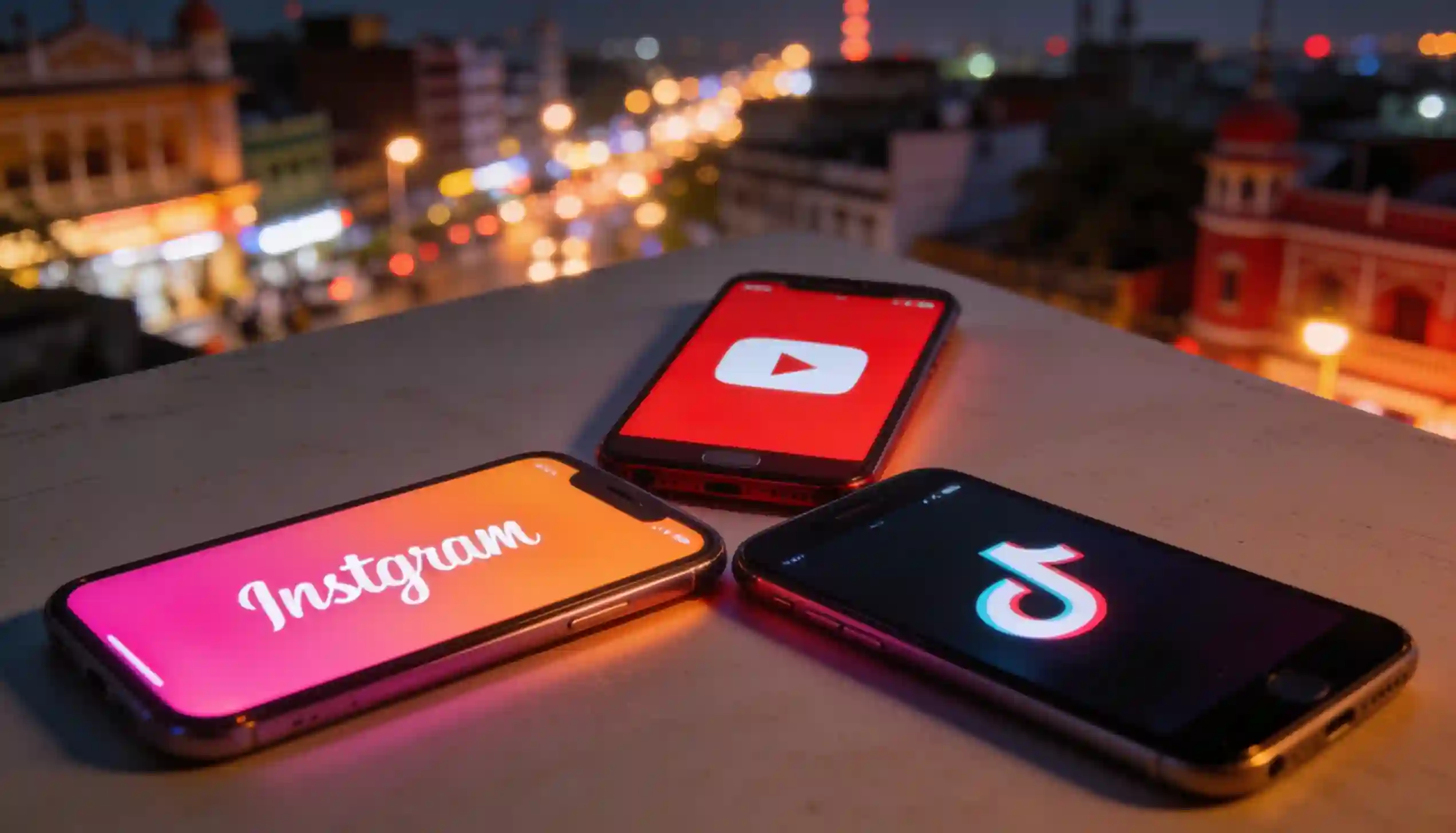
Any honest comparison of these three platforms for Indian creators has to start with the elephant in the room: TikTok remains banned in India as of 2026, and that ban has been in effect long enough that the platform’s direct relevance for India-based audience building is close to zero for most creators. You cannot legally operate a TikTok account targeting the Indian domestic market. Any strategy built on TikTok as a primary audience-building platform for Indian viewers is built on ground that doesn’t exist.
And yet TikTok is not irrelevant to Indian creators — for two specific reasons. The first is the diaspora opportunity. There are approximately 32 million people of Indian origin living outside India, with large concentrations in the US, UK, Canada, Australia, and the Gulf. These communities are not subject to India’s ban, and they are reachable through TikTok content in Hindi, Tamil, Telugu, Punjabi, and other Indian languages. Indian creators targeting diaspora audiences — particularly in entertainment, food, fashion, and cultural content — can build significant TikTok audiences abroad while maintaining their primary domestic platform elsewhere.
The second reason TikTok matters is its global influence on short-form video formats that have migrated to platforms that are available in India. The content formats, editing styles, audio trends, and creator archetypes pioneered on TikTok continue to shape what performs on Instagram Reels and YouTube Shorts — both of which operate freely in India. Understanding TikTok as a format laboratory, even for creators who never post on it, is part of understanding what short-form content works anywhere in 2026.
For Indian creators whose audience is primarily domestic, however, TikTok is not a strategic platform. The comparison that actually matters for most Indian creators is Instagram versus YouTube — and that comparison is more nuanced and more consequential than the global version of the same debate.
YouTube in India: The Scale Argument Is Overwhelming
India is YouTube’s largest market by active user count. Over 500 million Indians use YouTube regularly, across a demographic and linguistic spread that no other platform comes close to matching in the country. Regional language content in Hindi, Tamil, Telugu, Bengali, Marathi, Kannada, Malayalam, and Gujarati has all found massive, monetisable audiences on YouTube in ways that have not been replicated on Instagram or any other platform. The depth of YouTube penetration into non-metro India — into tier-2 and tier-3 cities, into rural communities, into age groups that other platforms haven’t reached — is the defining fact of the Indian creator landscape that anyone giving platform advice needs to understand before recommending anything else.
YouTube’s monetisation infrastructure is also significantly more developed for Indian creators than any competing platform. The YouTube Partner Programme, channel memberships, Super Thanks, merchandise shelf, and the YouTube Premium revenue share all provide diversified income streams that Indian creators can access with relatively low subscriber thresholds compared to what equivalent audiences on Instagram would generate. A YouTube channel with 100,000 subscribers in a mid-sized Indian city making long-form Hindi content can generate meaningful monthly income from AdSense alone. The Instagram equivalent — 100,000 followers in the same city making Reels — generates nothing from the platform directly and requires brand partnerships to monetise, which typically require a more urban, English-fluent, higher-income audience to attract.
YouTube’s algorithm in India has also proved more willing to surface regional language content to relevant audiences than Instagram’s, which has historically prioritised English-language content in its recommendation systems. This is changing, but YouTube’s decade-long head start in regional language content means its recommendation model understands Indian linguistic audiences in ways that Instagram’s is still catching up to.
The strongest argument for YouTube as a primary platform for Indian creators is that it’s the one platform where the Indian audience — in its full geographic, linguistic, and socioeconomic diversity — actually is. If your ambition is to build a genuinely large Indian audience, YouTube is where that audience lives.
Instagram in India: The Urban Credibility Layer
Instagram’s India story is different from YouTube’s, and the difference matters enormously for creators thinking about where to focus. Instagram’s active Indian user base is large — over 350 million users — but it skews significantly toward urban, educated, English-fluent, higher-income demographics in ways that YouTube does not. This skew is both Instagram’s limitation and its strategic value for certain types of creators.
The limitation is reach. If you’re making content in a regional Indian language for a broad Indian audience, Instagram is not the primary platform where that audience lives or where you’ll build your largest following. The algorithmic biases and demographic concentration of Indian Instagram mean that Hindi-language content, regional food content, and rural India perspectives consistently underperform on Instagram relative to their performance on YouTube.
The strategic value is commercial. The urban, higher-income Indian Instagram audience is the audience that Indian brands most want to reach. Fashion brands, beauty companies, D2C startups, food delivery platforms, ed-tech companies, and consumer electronics brands all pay significant sponsorship rates for access to exactly the demographic that dominates Indian Instagram. A creator with 80,000 engaged Instagram followers in the 22–35, metro, English-speaking demographic can command brand deal rates that a YouTube creator with ten times the subscriber count in a broader demographic might struggle to match.
Instagram also functions as an essential credibility layer for Indian creators whose monetisation strategy extends beyond advertising and into speaking engagements, consultancy, personal branding, and entrepreneurship. The perception of Instagram as the platform where India’s aspirational class operates means that a strong Instagram presence signals status and influence to collaborators, brand managers, and professional contacts in ways that even large YouTube numbers don’t always achieve in the same circles. This perception is somewhat irrational but entirely real in its practical effects on creator career outcomes.
For Indian creators targeting urban audiences with content relevant to brand sponsorship categories, Instagram is not optional — it’s where the commercial opportunity concentrates. Using buy Instagram followers services to establish credible baseline follower counts matters particularly in this context, because brand managers evaluating creators for sponsorship deals use Instagram follower count as a primary filter before engaging further. A profile that passes the follower threshold gets considered; one that doesn’t rarely does, regardless of how strong the content engagement rate is.
Reels vs Shorts: The Short-Form Battle India Is Actually Fighting
The TikTok ban redirected the extraordinary short-form content energy of Indian creators — a cohort that had built some of the platform’s most culturally distinctive content — into two main destinations: Instagram Reels and YouTube Shorts. Five years on, both formats are mature, both have significant Indian creator communities, and the strategic differences between them matter for how Indian creators should allocate their short-form content effort.
Instagram Reels has the stronger urban creator community and the better brand discovery infrastructure. Reels that perform well in the urban Indian creator space get significantly more brand attention than equivalent YouTube Shorts performance. Reels are also more discoverable by urban Indian users in the 18–30 demographic, which makes them more effective for building the type of audience that monetises through sponsorship deals in lifestyle, beauty, fashion, and tech categories.
YouTube Shorts has the broader reach and the better monetisation fundamentals. The YouTube Shorts fund and the integration of Shorts monetisation with the broader YouTube Partner Programme means that Shorts views contribute to a creator’s overall channel revenue in a way that Instagram Reels views don’t. For creators who are primarily building a YouTube channel and using short-form content as a discovery funnel, YouTube Shorts is the obvious choice because it feeds directly into the same ecosystem where their long-form content monetises.
The practical conclusion for most Indian creators is that short-form content should be produced once and adapted for both formats, rather than choosing one exclusively. The editing requirements differ slightly between the two platforms, but the core content — hook, value delivery, call to action — transfers well. Duplicating short-form distribution effort rather than concentrating it is the approach that generates maximum reach across the full Indian creator audience.
Language Strategy: The Dimension Most Platform Advice Ignores
The language in which an Indian creator makes content is a more significant platform strategy variable than most global creator advice acknowledges — because language determines which platform’s audience is most accessible and which algorithm is most likely to surface your content to the right viewers.
Hindi content performs across all three platforms but with different ceiling heights. On YouTube, Hindi content can reach audiences numbering in the hundreds of millions, spanning virtually every demographic in the country. On Instagram, Hindi content reaches a narrower urban Hindi-speaking audience but can generate stronger brand deal opportunity within that narrower group. On TikTok internationally, Hindi content has a defined diaspora audience that is enthusiastic and underserved.
Regional language content — Tamil, Telugu, Bengali, Marathi, Kannada, and others — has found its most receptive platform environment on YouTube, where regional language channels have built audiences in the tens of millions and where the monetisation infrastructure is developed enough to support full-time creator careers in regional languages. Instagram’s regional language creator ecosystem is growing but is still significantly smaller and less monetised than the equivalent YouTube communities. For creators making content in a regional Indian language, YouTube is not one option among several — it is overwhelmingly the primary platform, and building there first before considering Instagram as a secondary brand-credibility layer is the logical sequencing.
English-language Indian content sits in a unique position. English-speaking Indian creators can build genuinely global audiences on all three platforms, competing not just for Indian attention but for international viewers who engage with Indian perspectives on culture, business, technology, and lifestyle. For this creator cohort, TikTok’s international availability is actually relevant — an English-language Indian creator can build significant TikTok presence in the UK, US, and Australian markets while maintaining Instagram and YouTube for Indian and international crossover audiences. This is a multi-platform strategy that requires more resource investment but opens significantly larger total addressable audience than any single-platform approach.
Monetisation Comparison: Where Indian Creator Money Actually Comes From
The monetisation landscape for Indian creators in 2026 differs from Western markets in ways that should directly influence platform priority decisions.
YouTube AdSense CPM rates in India are significantly lower than in Western markets — typically $1 to $3 per thousand views compared to $5 to $20 in the US or UK. This means that YouTube monetisation in India requires significantly higher view counts to generate income comparable to a Western YouTube creator. A hundred thousand views in India generates revenue that a US creator might produce from ten thousand views. This doesn’t make YouTube monetisation unworkable for Indian creators — the platform’s massive Indian audience means that volume is achievable in ways it isn’t in smaller markets — but it does mean that brand deals, channel memberships, and merchandise become proportionally more important components of Indian YouTube creator revenue than they are for Western equivalents.
Brand deal rates for Indian creators have risen substantially over the past three years as the Indian D2C economy has matured and as brands have developed more sophisticated understanding of creator audiences. Top-tier Indian YouTubers in categories like personal finance, technology review, and English-language education now command brand deal rates that are competitive with mid-tier Western creator rates. The growth trajectory in this area is strong, and the ceiling for Indian creator brand deal income is significantly higher in 2026 than it was even two years ago.
Using buy YouTube views services serves a specific function in the Indian creator monetisation context: view velocity on new content is the primary signal that determines whether YouTube surfaces a video to wider audiences, and in a high-volume, high-competition market like Indian YouTube, new content from smaller channels can disappear before accumulating enough early views to trigger algorithmic distribution. Seeding view velocity on a strong video — particularly one optimised for a high-CPM topic or a brand deal category — is a strategic investment in the monetisation potential of that specific piece of content, not just a vanity metric exercise.
The Platform Priority Framework for Indian Creators
Rather than prescribing a single answer to the Instagram versus YouTube versus TikTok question, the more useful framework organises platform priority around the three variables that matter most: audience language, content format, and primary monetisation goal.
If your content is in a regional Indian language and your primary monetisation goal is AdSense or channel memberships, YouTube is your primary platform with no serious competition for that position. Instagram is a secondary credibility layer for brand deals; TikTok is irrelevant to the domestic strategy but worth considering for diaspora reach in the specific language.
If your content is in Hindi and spans both long-form and short-form formats, a YouTube-primary strategy with consistent Instagram Reels presence gives you the broadest total reach with the best monetisation fundamentals. YouTube builds your largest and most monetisable audience; Instagram provides the brand deal credibility and urban audience access that YouTube’s broad demographic mix can obscure.
If your content is in English targeting aspirational urban Indian audiences with significant lifestyle, business, or technology themes, Instagram and YouTube deserve roughly equal investment as primary platforms, with TikTok as a viable international expansion layer once domestic presence is established. This is the creator profile with the widest total addressable market and the highest potential brand deal rates — and also the most competitive landscape, which is exactly why social media growth services that establish credible platform presence faster are most commonly used by creators in this cohort. The English-language urban Indian creator space rewards established social proof heavily, and reaching credible follower and view count thresholds faster creates compounding commercial advantages that justify early investment in growth infrastructure.

